Before the 16th century
Before Mirrorwork:
The Mirror as Object
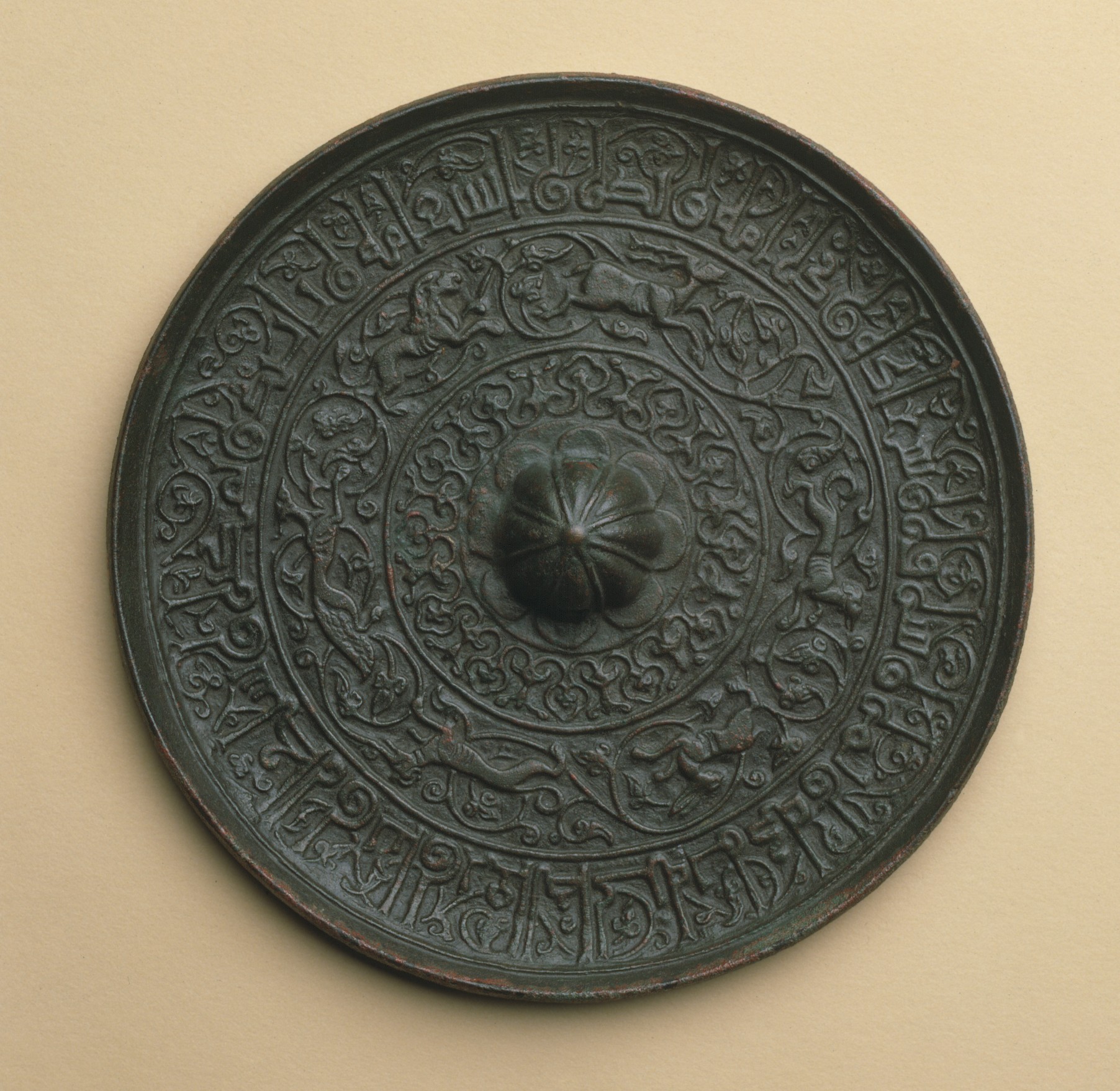
Mirrors were made and used in Iran long before mirrorwork appeared in architecture. Ancient objects of polished metal and later glass mirrors belong to a much longer material history. Ayeneh-kari took shape as mirrors were incorporated into walls, ceilings, columns, and architectural details, becoming integrated with geometry, plasterwork, and light. The mirror was thereby transformed into an architectural medium.
Safavid period
The Safavid Period:
Mirrorwork Enters Architecture
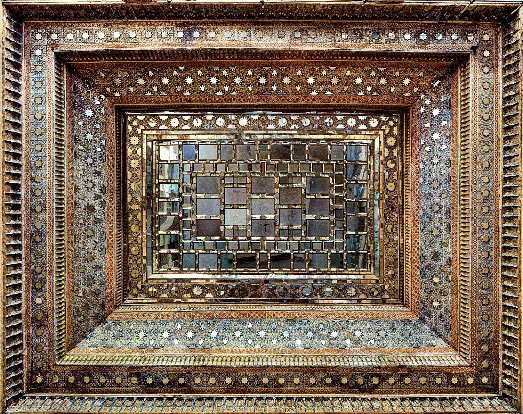
Architectural mirrorwork emerged in Iran during the Safavid period, following the arrival of large Venetian mirrors in the sixteenth century. Its earliest location has not been firmly established, although the Divankhaneh of Shah Tahmasp in Qazvin may have been among its first settings. After the royal court moved to Isfahan, mirrors appeared more extensively in palace interiors. Large mirror panels were incorporated into walls and ceilings, while other applications combined mirror with stucco, wooden gereh-chini, and convex glass. In buildings such as Chehel Sotoun and Hasht Behesht, the reflective surface became part of the architecture’s geometry and its orchestration of light.
Developing practice
From Surface
to Geometry
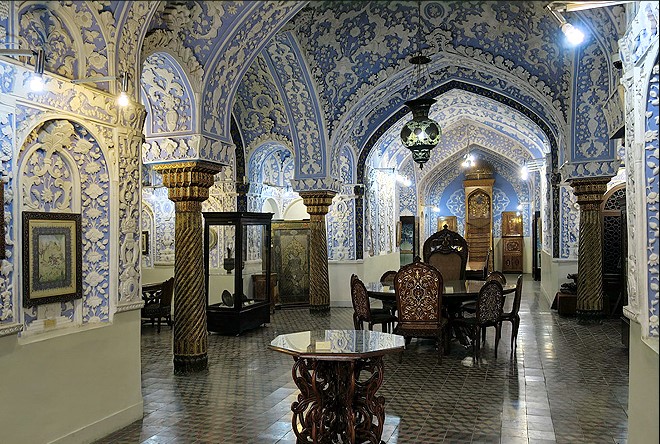
As mirrorwork developed, craftsmen cut mirrors into smaller pieces and assembled them within geometric systems already established in Iranian architecture. This practice drew on a long artisanal knowledge expressed through gereh-chini, muqarnas, stucco, and woodwork. Triangles, diamonds, polygons, and curved pieces were set into prepared plaster, allowing mirror to follow the contours of niches, vaults, columns, and ceilings.
In Iranian philosophical and poetic traditions, the mirror had long been associated with perception, disclosure, and self-knowledge; light with the passage from invisibility into appearance; and multiplicity with manifestations of an underlying unity. Mirrorwork gave these established ideas a material and architectural form through fragmented reflection and geometric order.
18th–20th centuries
The Qajar Expansion
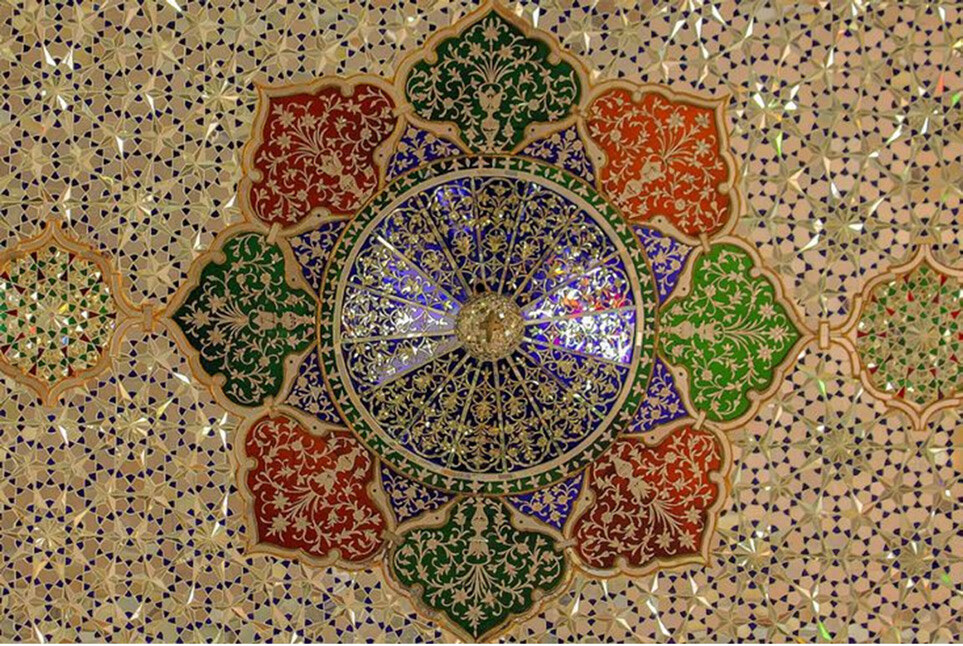
During the Qajar period, mirrorwork expanded in scale, technique, and architectural setting. It appeared across royal palaces, affluent houses, garden pavilions, and religious buildings in cities including Tehran, Shiraz, Isfahan, and Mashhad. Large mirrors remained in use, while increasingly complex surfaces were constructed from precisely cut fragments.
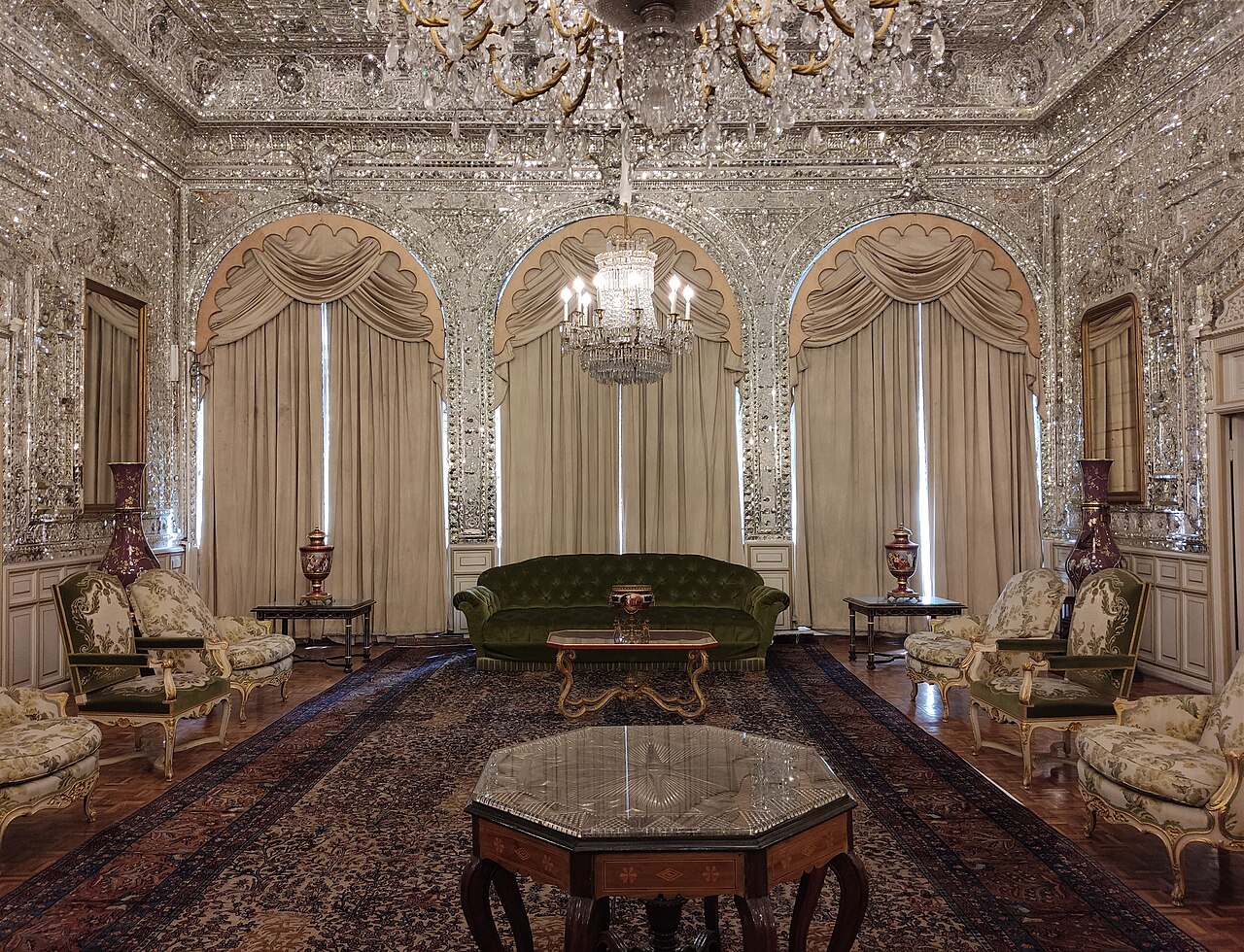
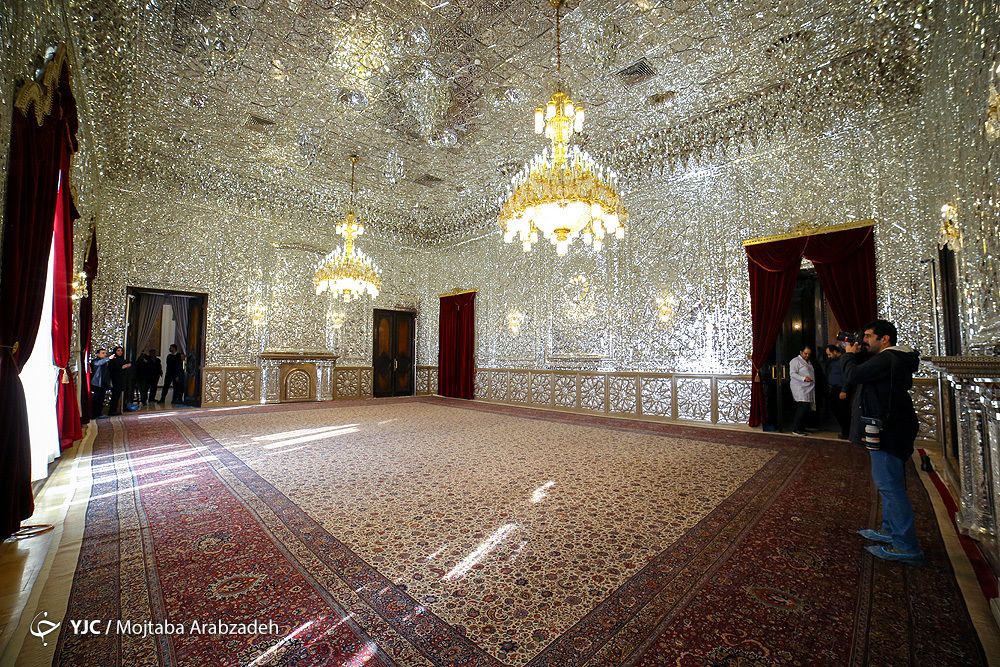
Techniques such as almas-neshan, mirror-on-mirror, relief and high-relief mirrorwork, painting on and behind mirrors, and combinations of mirror and stucco broadened its material vocabulary. In spaces such as the Hall of Mirrors and Shams ol-Emareh at Golestan Palace, Narenjestan-e Qavam, and Zinat al-Molk House, walls and ceilings became expansive compositions of geometry, image, colour, and reflection.
Mirror Hall, Golestan Palace, Tehran, Qajar period. Mirrorwork extends across the walls and ceiling as part of an elaborate architectural composition. Photograph: Parsa 2au, 2022. CC BY-SA 4.0.
1930–2025
The Pahlavi Period:
Continuity and Recognition
During the Pahlavi period, mirrorwork continued through the restoration of historic buildings and new architectural commissions, including royal interiors such as Marble Palace and Green Palace.
Alongside workshop-based apprenticeship, this period saw the development of institutions that formalized the transmission of traditional arts and the preservation of architectural knowledge.
The School of Ancient Arts, established in 1930 as the country’s first formal centre for traditional arts, created an educational structure beyond the workshop. From 1965, the National Organization for the Preservation of Historic Monuments established provincial technical offices and used conservation sites as training grounds for Iranian technicians and restorers. These educational and conservation structures provided essential support for preserving historic interiors and transmitting the material knowledge through which practices such as mirrorwork have reached the present.
In recent decades, practitioners have maintained hand-cut techniques while also working with coloured and industrial mirrors, new adhesives, and contemporary architectural settings. Apprenticeship remains central, while universities and specialized training institutes provide additional paths for learning and transmission.
Ayeneh-kari was added to Iran’s National Inventory of Intangible Cultural Heritage in 2017. In 2025, UNESCO inscribed “Ayeneh-Kari, the art of mirror-work in Persian architecture” on the Representative List of the Intangible Cultural Heritage of Humanity. The inscription recognizes it as a continuing body of knowledge sustained through making, teaching, restoration, and new architectural work.
Research
Selected Sources
- 01
Sheikhi, Alireza. “New Findings and Cultural Analysis of Mirror Work in Iranian Historical Buildings from the 10th Century AH to the Contemporary Era.” Journal of Art & Civilization of the Orient, vol. 13, no. 49, 2025, pp. 62–75. DOI ↗
- 02
Sheikhi, Alireza, and Razieh Salemi. “An Analysis of Mirrorwork Techniques and Motifs in the Historical Buildings of Isfahan.” Peykareh, vol. 12, no. 32, 2023, pp. 88–106. In Persian. DOI ↗
- 03
Aliabadi, Mohammad, and Somayeh Jamalian. “A Study of Mirrorwork Patterns in Qajar Buildings of Shiraz.” Negareh, no. 23, 2012, pp. 17–29. In Persian.
- 04
Galdieri, Eugenio, and Keramat-Allah Afsar. “Conservation and Restoration of Persian Monuments.” Encyclopaedia Iranica, vol. VI, fasc. 2, 1992, pp. 134–138. Read ↗
- 05
Najafipour, Akram. “The First Formal Centre for Traditional Arts Education in the Modern Period.” Office of Educational Publications and Technology, 2018. In Persian. Read ↗
- 06
UNESCO. “Ayeneh-Kari, the Art of Mirror-Work in Persian Architecture.” Representative List of the Intangible Cultural Heritage of Humanity, 2025. Record ↗