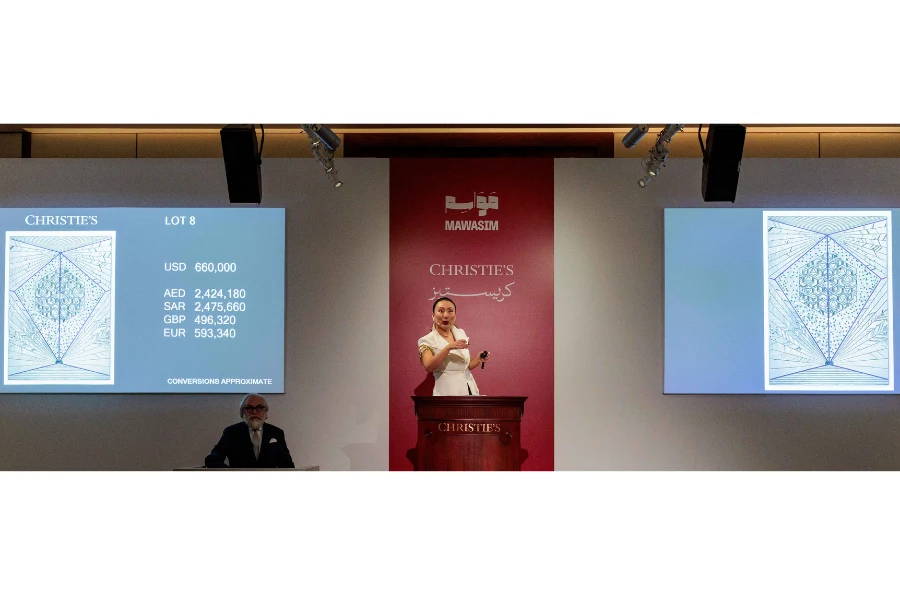
MAWASIM: 20 Years of Modern and Contemporary Middle Eastern Art was held at The Abu Dhabi EDITION on 1 November 2026. The work was estimated at $150,000–250,000, but nearly seven minutes of competitive bidding pushed the final price to more than three times the high estimate. The auction achieved a total of $8,940,800.
A Work Created for the Victoria and Albert Museum
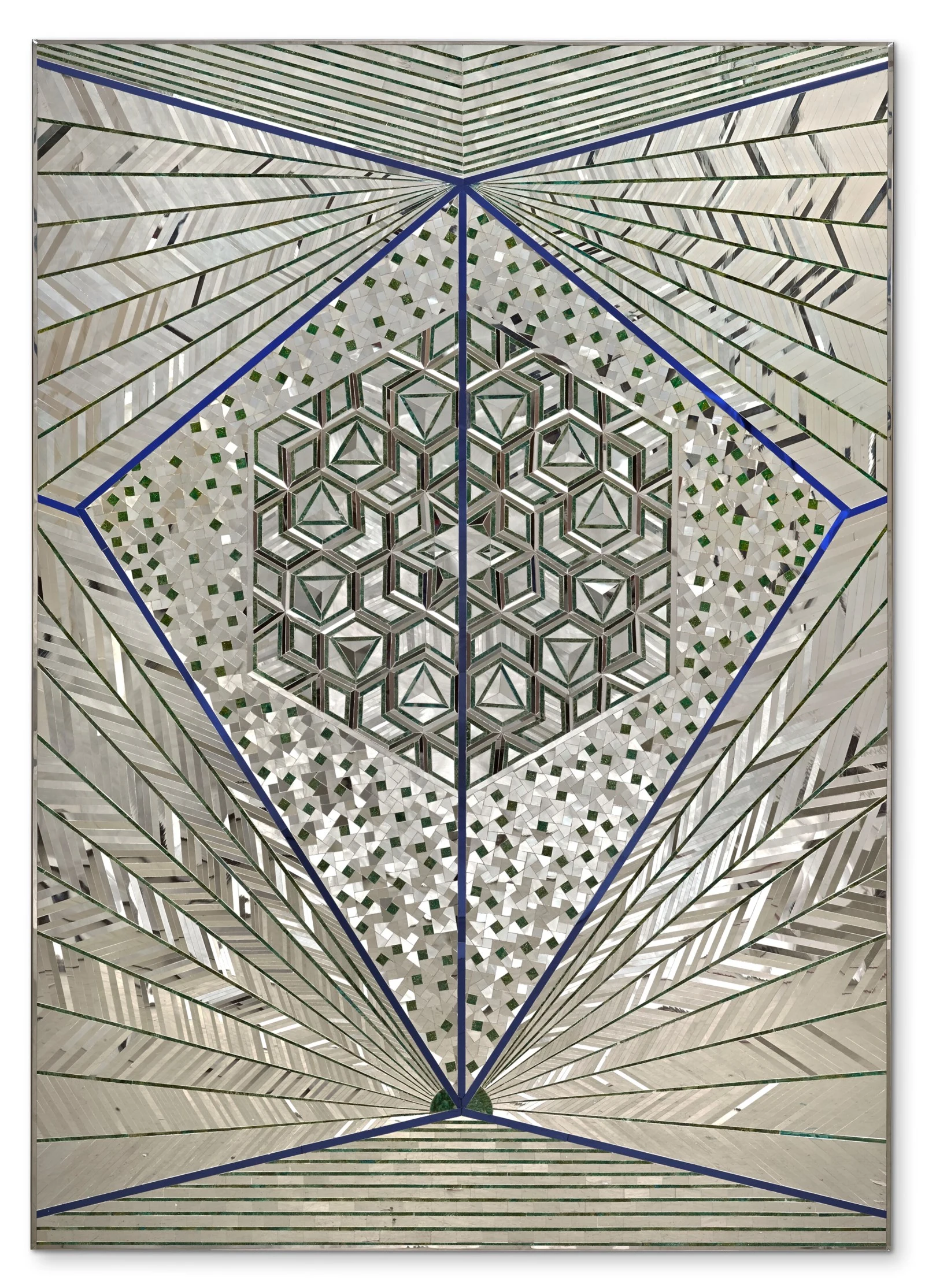
Variations on the Hexagon was created in Farmanfarmaian’s Tehran studio in 2006. The panel sold at Christie’s was one of six monumental panels commissioned for the opening of the Jameel Gallery of Islamic Art at the Victoria and Albert Museum in London.
Measuring 183 by 130 centimetres, the panel is made of mirror mosaic, blue glass, reverse-glass painting and plaster on wood. Its composition is structured around a series of interlocking hexagons that extend outwards from the centre, generating a complex network of geometric relationships through successive divisions and repetitions.
“For me everything connects with the hexagon.”Monir Shahroudy Farmanfarmaian
She associated its six sides with the six spatial directions—forward, backward, right, left, up and down—and with six virtues: generosity, self-discipline, patience, determination, insight and compassion.
The geometry of the work remains fixed, while its image changes with the light, its surroundings and the position of the viewer. Each piece of mirror reflects part of the surrounding space, drawing the viewer’s presence into the composition.
The panel was exhibited at the Jameel Gallery at the Victoria and Albert Museum in 2006 and in Farmanfarmaian’s 2008 exhibition at Zentrum Paul Klee in Bern. Another of the six panels is now held in the V&A’s permanent collection.
Iranian Mirrorwork as an Autonomous Artwork
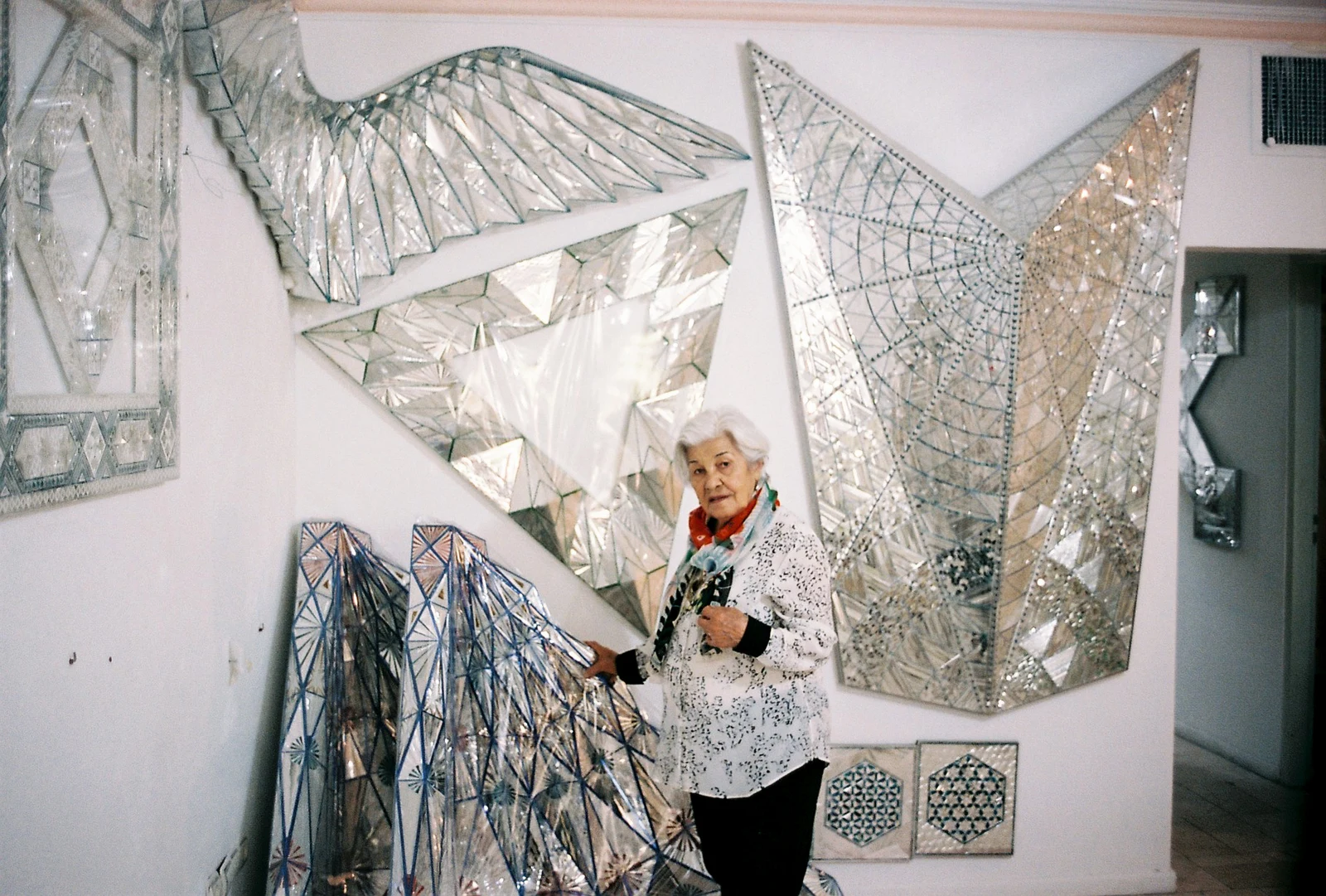
Monir Shahroudy Farmanfarmaian was one of the most important figures in bringing Iranian mirrorwork from architectural surfaces into the form of an autonomous artwork. From the 1970s onwards, she worked with Iranian craftspeople, combining the knowledge of mirrorwork with her studies of geometry, abstract art and reverse-glass painting.
In her work, mirrorwork moved from the walls, ceilings and architectural spaces of Iran onto an independent surface that could be presented in museums, galleries and art collections around the world. This shift gave audiences without direct experience of Iran’s mirrorwork interiors a way to encounter the art form.
The recent sale of Variations on the Hexagon shows how a work grounded in the geometric knowledge and craftsmanship of Iranian mirrorwork can occupy a central position in one of the region’s most significant art-market events.
Primary links