Reflection 03 / Language and cultural memory

Har Ayeneh:
Mirrorwork and Time

Iranian mirrorwork in the context of Persian culture and literature.

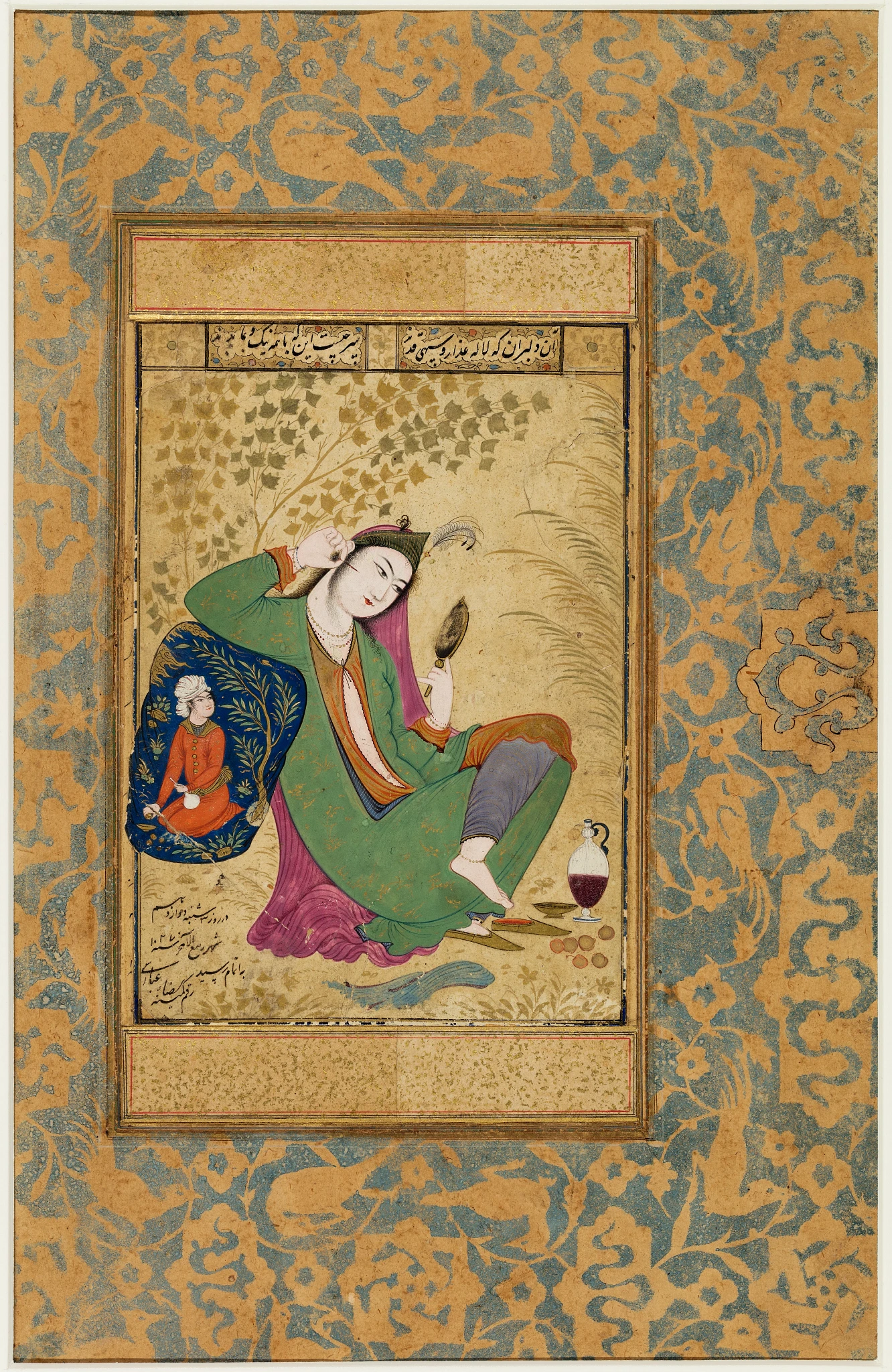
A seated woman holding a small mirror in Reza Abbasi’s Lady with a Mirror
Reza 'Abbasi, Lady with a Mirror, 1618 or 1627, opaque watercolor, ink, and gold on paper. Detroit Institute of Arts, Gift of Mrs. Edsel B. Ford, 44.274.

Iranian mirrorwork is interactive and reflective by nature. Its geometric compositions do not produce a single, fixed image. As light changes and people move through a space, each fragment receives and returns a different part of its surroundings. What unfolds before the work continually remakes it.

Persian literature can be understood as one of the dimensions of the cultural context in which Iranian mirrorwork took shape and through which its continuity acquired meaning. Persian language and poetry do more than reflect this context; they have also preserved ways of perceiving light, reflection, appearance, and transformation. Following the presence of the mirror through the history of Persian literature can therefore open another horizon from which to read the perceptual logic of Iranian mirrorwork.

The Persian expression har ayeneh offers a thought-provoking linguistic point of departure for considering this temporal quality. In contemporary Persian script, it can be separated into har and ayeneh and read literally as “each mirror.” Historically, however, the compound followed a different semantic path. Persian dictionaries relate ayeneh in this expression to older meanings such as manner, course, or state. Har ayeneh has consequently been used to mean “certainly,” “inevitably,” or “in any case.”

Hafez, for example, writes: “A breaker of covenants will har ayeneh become broken in spirit.” Here the expression affirms the certainty and inevitability of the consequence; it does not refer to a physical mirror.

Yet the visual presence of the word ayeneh within the expression makes another reading possible. This possibility becomes especially resonant in poetry, where spacing, repetition, syntax, rhyme, and proximity to the image of an actual mirror can draw the two meanings together.

An early and illuminating example appears in a qasida by Farrokhi Sistani, the eleventh-century poet. Across the poem, Farrokhi repeatedly begins his statements with har ayeneh ke. The expression introduces a sequence of transformations: spring is concealed when autumn appears; the world darkens when the sun disappears; fear draws the arrow towards the bow; and thunder groans as lightning opens its mouth in laughter.

هر آینه که ز دیدار آفتاب شود
به کوه سنگ عقیق و به دشت گل عقیان

Whenever it comes into the sight of the sun,
the mountain’s stone becomes agate and the plain’s flowers pure gold.

Historically, har ayeneh here does not denote a physical mirror, nor does it simply mean “at every moment.” It gives transformation the force of recurrence and necessity: when the sun appears, the world is inevitably changed by its light. Stone, landscape, colour, and value assume another form through illumination.

The repetition of the expression creates a particular experience of time. Each appearance announces an event that happens again while producing a new condition. Autumn emerges, sunlight retreats, the landscape changes colour, and matter assumes another form. Time is not described in the abstract; it becomes perceptible through transformations of light, surface, and the visible world.

In later poetry, the latent proximity between har ayeneh and the physical mirror becomes more explicit. Rumi writes:

دلا خود را در آیینه چو کژ بینی هرآیینه
تو کژ باشی نه آیینه، تو خود را راست کن اول

Heart, whenever you see yourself crooked in the mirror,
it is you who are crooked, not the mirror; first set yourself straight.

Within a single couplet, ayeneh names the reflective object while har ayeneh emphasizes the certainty of a judgment. The repetition is neither merely visual nor sonic. It places the mirror beside a proposition about perception: what appears on the reflective surface cannot be separated from the condition of the person standing before it.
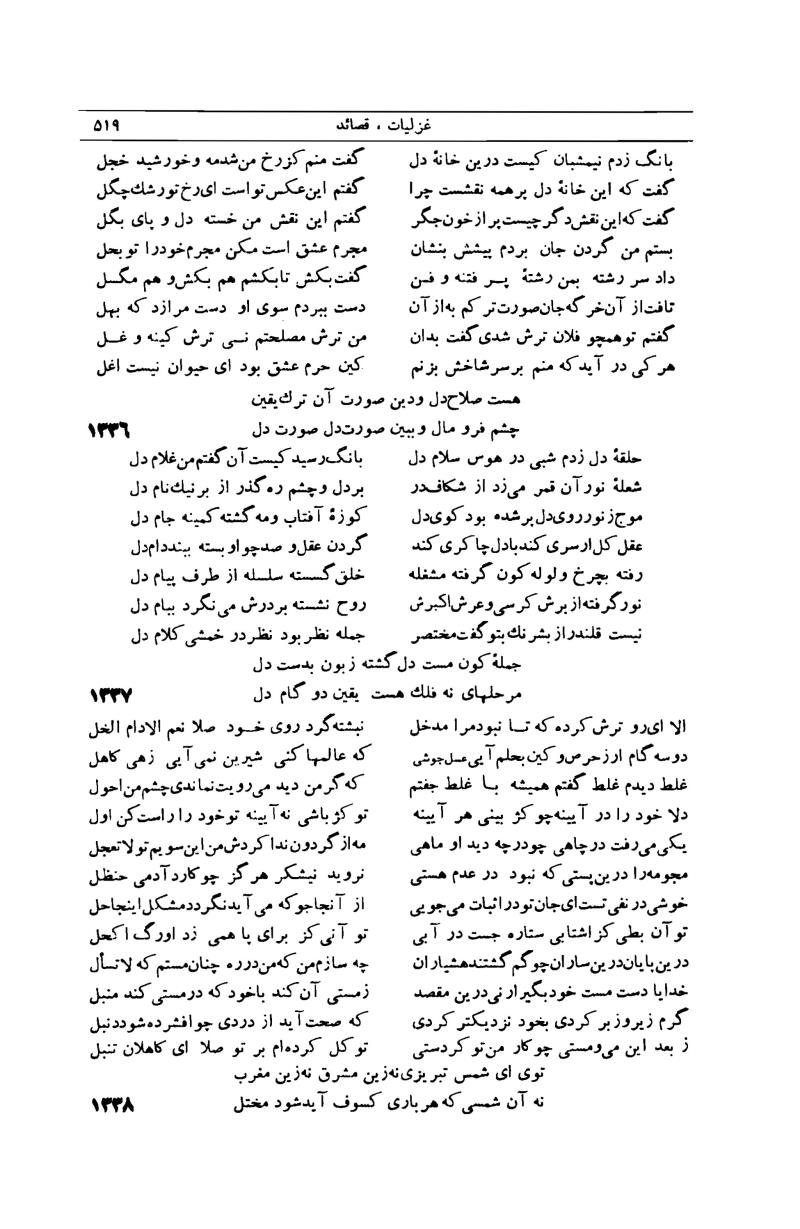
Printed page containing Rumi’s Ghazal 1337 and the verse about seeing oneself in a mirror
Rumi, Ghazal 1337, in Kolliyat-e Shams-e Tabrizi, Amir Kabir, Tehran, 1997. Image 509 of the Ganjoor Museum digital collection.

Jami brings the two meanings together with a different subtlety:

گفتم توان جمال تو دیدن، به عشوه گفت
گر صاف‌دل چو آینه باشی هرآینه

I asked, “Can your beauty be seen?” Coquettishly, the beloved replied:
“Certainly—if you are clear-hearted like a mirror.”

Here ayeneh and har ayeneh converge within one structure. The possibility of seeing depends both on the certainty of the reply and on the quality of the surface and the state of the viewer: a heart made clear like a mirror.

In the poetry of Mohammad-Taqi Bahar, the relation expands from a single mirror to a multiplicity of mirrors:

چندین هزار آینه بینی پر از نقوش
گر برنهی برابر یکدیگر آینه
چون نیک بنگری همهٔ نقش‌ها یکی‌ست
بر تو یکی هزار نماید هر آینه

You see many thousands of mirrors filled with images
if you set mirrors facing one another.
When you look closely, all the images are one;
the one appears to you as a thousand in each mirror.

In these lines, the multiplication of reflections does not dissolve the unity of the image: one image appears across thousands of surfaces. Placed directly beside the many mirrors, har ayeneh can momentarily be heard both as an adverb of certainty and as “each mirror.” This simultaneity establishes a clear relation with the logic of mirrorwork, where the unity of an image is divided among multiple fragments and reorganized.

Source: Mohammad-Taqi Bahar, “On the Unity of Existence.” Read the complete poem in Ganjoor ↗

Read together, these literary uses open a cultural horizon for Iranian mirrorwork—one in which reflection, appearance, recurrence, certainty, transformation, and multiplicity have also assumed tangible forms in Persian language and poetry.

In Iranian mirrorwork, the mirror is no longer primarily an instrument for seeing a complete image of the face. Divided into numerous geometric fragments, it breaks the authority of a single viewpoint. Each piece receives a different field of light and a different portion of the surrounding space. The viewer moves, the sun changes position, and the reflected world is reorganized.

If mirrorwork is read through the productive ambiguity of har ayeneh, each mirror can also be understood as each event: a surface upon which another moment becomes visible. The mirrored fragments do not preserve time as a fixed image. They register its passage through changing intensities, movements, appearances, and disappearances.

Perhaps this is why time feels so present in Iranian mirrorwork. The mirror does not only reflect space; it translates time into a geometry of reflection and form. Every encounter produces an image that exists only within that particular condition of light, position, and presence. The work does not merely exist in time; it makes time perceptible.

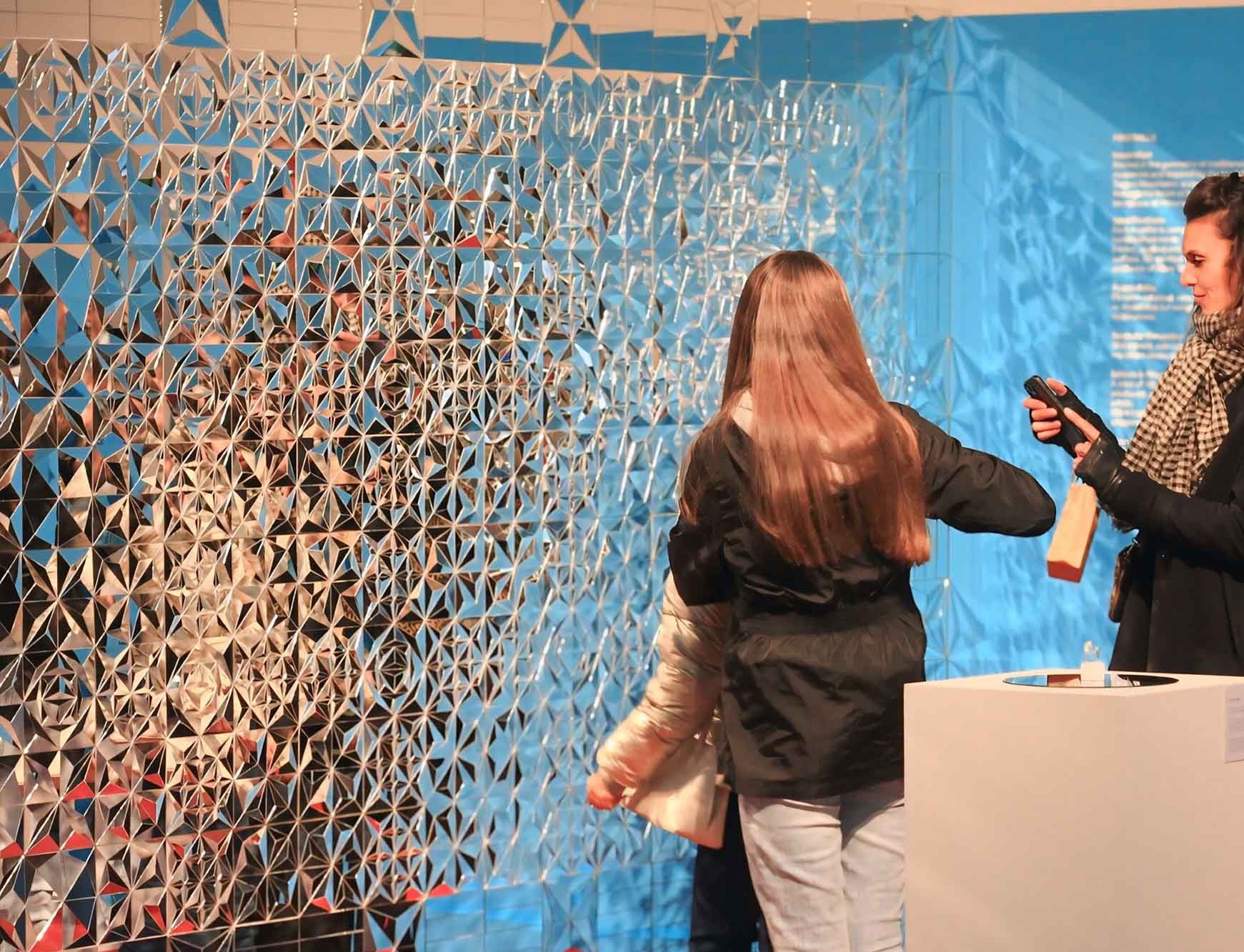
Visitors reflected across the fragmented geometric surface of Rose Garden (Golestan), an Iranian mirrorwork installation by mirroRE at Dutch Design Week 2025
Visitors encountering Rose Garden (Golestan), mirroRE, Dutch Design Week 2025. Photo: mirroRE.

Persian edition

نسخهٔ فارسی

The original Persian text is available as a designed PDF.

Download PDF

Selected sources

  1. “Har Ayeneh,” Dehkhoda Dictionary, Vajehyab.
  2. Farrokhi Sistani, Qasida 162, Ganjoor.
  3. Hafez, Ghazal 312, Ganjoor.
  4. Rumi, Ghazal 1337, Ganjoor; printed page in the Ganjoor Museum.
  5. Jami, Ghazal 869, Ganjoor.
  6. Mohammad-Taqi Bahar, “On the Unity of Existence”, Ganjoor; printed page in Naskban.
  7. Reza 'Abbasi, Lady with a Mirror, Detroit Institute of Arts.

English translations of the cited verses are provided for this essay.

Return toReflections